WOH Hydropneumatic Tank Guide
Hydropneumatic tanks store water under compressed air to maintain system pressure between pump cycles and reduce pump short-cycling. This guide covers tank types, pressure settings, maintenance, and troubleshooting for drinking water operators.
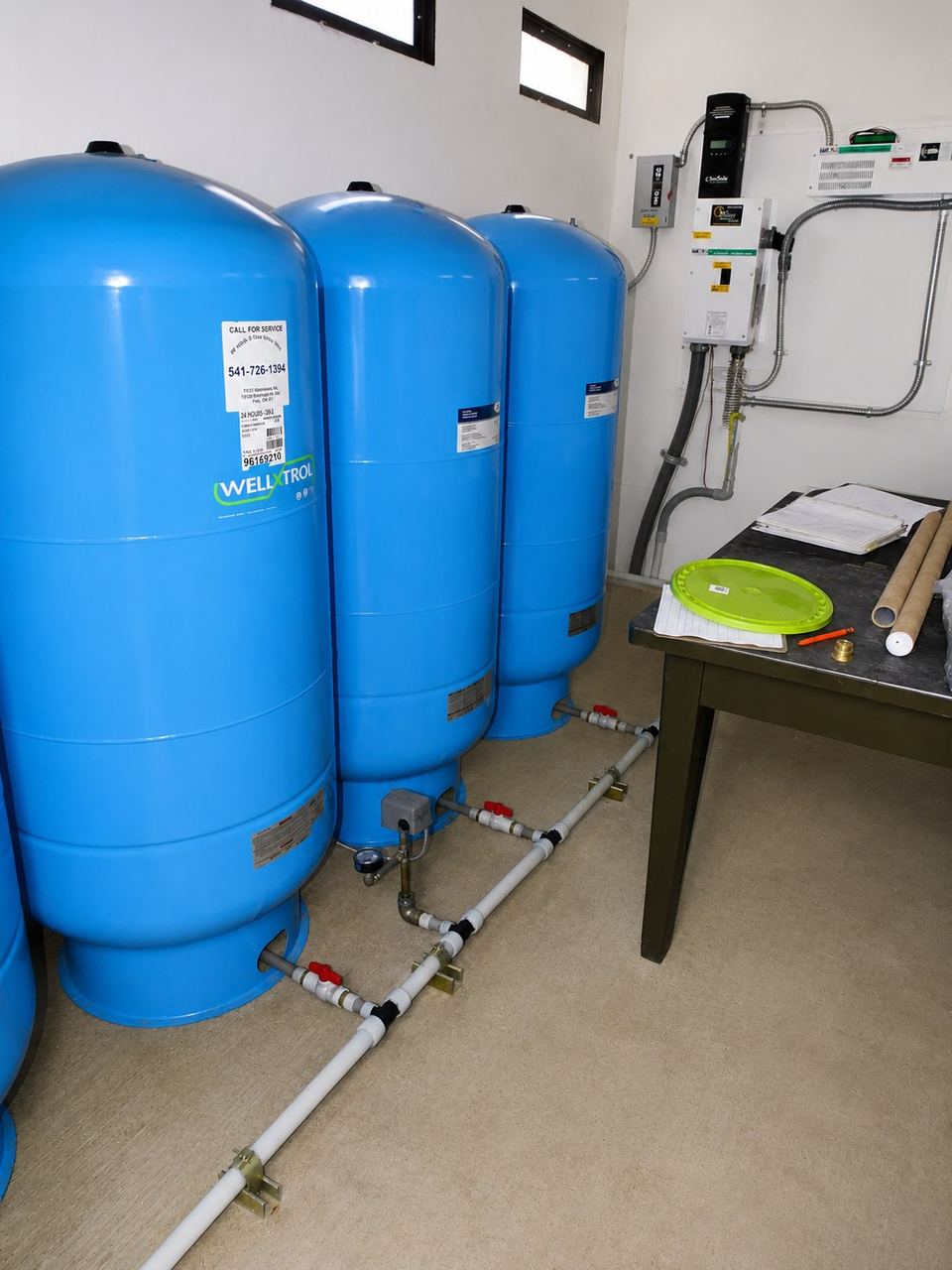
A hydropneumatic tank works by using compressed air as a spring. When the pump fills the tank, water compresses the air charge. As water is drawn from the system, the compressed air pushes water back out, maintaining pressure until the air expands enough that system pressure drops to the pump cut-in setpoint. The volume of water delivered between pump starts is called drawdown and depends on tank size, air pre-charge pressure, and the cut-in/cut-out pressure differential. A waterlogged tank (one that has lost its air charge) has near-zero drawdown and will cause the pump to short-cycle continuously.
Three common tank types are galvanized (plain steel with air and water in direct contact), bladder (with a flexible separator), and diaphragm (with a fixed separator). Galvanized tanks require periodic air replenishment because air dissolves into the water over time; bladder and diaphragm tanks maintain a stable pre-charge if intact, but their separators eventually fail and require replacement. Bladder tanks typically last 5–15 years before bladder replacement; diaphragm tanks have similar service life. Galvanized tanks can last 20–30 years but risk internal corrosion and water quality degradation.
Key components include the pressure switch (starts and stops the pump at set pressures), pressure gauge (for real-time observation), pressure relief valve (safety device preventing overpressure), check valve (prevents backflow from the tank), drain valve (for flushing sediment), and the Schrader air valve (on bladder and diaphragm tanks, used to check and adjust air pre-charge when the system is completely depressurized). Maintaining correct air pre-charge is the most important routine maintenance task; if water discharges from the Schrader valve, the bladder or diaphragm has failed and requires immediate service.
Source document
WOH_Hydropneumatic_Tank_Guide.pdf
application/pdf · 65.2 KB
Become a member to view the full 31 min readMore with similar tags

Storage Tank Inspection: What to Look For and When to Act
Your storage tanks are one of the most vulnerable points in your distribution system. A systematic inspection approach catches problems before they become violations.
2 min read
Well Pump Troubleshooting for Small Water Systems
A pump that won't start, won't keep pressure, or runs constantly is telling you something. Here's a systematic approach to diagnosing the most common well pump problems.
3 min readNeed expert help with your water system?
Water Operator Hotline connects small public water systems with experienced water utility professionals who can help you stay compliant, maintain your equipment, and solve problems fast.